Know It Before You Throw It Back
He had a 9-carat diamond in his hand. He thought it was glass. Kevin Kinard carried his stone around the search area for hours because it looked interesting and shiny, and he almost did not bother having his finds checked. It weighed 9.07 carats — the second largest recovered at that park in forty-eight years. His own words afterwards were that he just thought it might have been glass.
$49$29
$29 — the book, one PDF, delivered to your inbox
Secure Stripe checkout · the PDF arrives by email within a minute · 60-day Second Look Guarantee, and you keep the file

Nobody connected with this book claims to have stood on any ground, and there are no field anecdotes in it. Every load-bearing sentence carries a named source with the date it was read, and every chapter ends with a section called Check me that lists them by author, publication, edition and page.
Not one of these is about luck, and not one of them is about how hard you work. Each maps to a chapter that fixes it.
You have a container somewhere — a coffee can on the workbench, a bucket by the back steps, a jar somebody carried up from a creek eleven summers ago. The best-documented cases in this country are exactly that. One man took his 9.07-carat stone for glass. Another described the 3.81-carat brown stone he had just picked up as looking like a Werther's candy wrapper on the ground.
Faceted, on velvet, under a jeweller's lamp. That is the picture in your head, and it is a picture of something a cutter made. What comes out of American gravel is rounded, averages about a quarter of a carat — a paper matchhead — and has lost roughly sixty to eighty percent of its weight dissolving on the way up. Rice grains and flattened pebbles are ordinary. Hunting the textbook octahedron is precisely how a man walks over the real thing.
Rough diamond does not sparkle. Sparkle is what a cutter puts into a stone at chosen angles, and nothing in your screen has been touched by one. What you are reading is luster — how a surface hands light back — and a man sweeping gravel for a jewellery-counter flash will pass over every one of them. The rainbow that beginners photograph and post is usually light in the fractures of a cracked rock, the same effect as a soap bubble.
Scratching a windowpane proves hardness above about five and a half, which quartz at 7 and topaz at 8 do just as well. A streak plate is softer than diamond, so the stone scratches the plate and you have abraded a specimen that has already lost most of its mass. An electronic tester is built for the flat table of a cut stone, and its own instructions say so. And nobody identifies a rough stone from a photograph, which is why experienced people close those threads every time.
Diamond runs 3.50 to 3.53 grams per cubic centimetre. Quartz runs 2.65, so diamond does sort by density and does concentrate. But it is nothing like as dense as the heavy metals, so it keeps travelling long after they have dropped out of the current — alluvial diamond is found as far as a thousand kilometres from its source. The traps that hold the heavy stuff are not the traps that hold this. That is an error of physics, not of style.
The question nobody answers. Between 1876 and 1913 diamonds turned up in at least seven localities in southern, central and western Wisconsin, every one of them in Pleistocene glacial deposit or Holocene river gravel. Where they came from is still two live hypotheses — a source across the ice at least 800 kilometres away, or something much nearer to home — and this book hands you both instead of picking the one that reads better.
Three movements, and each chapter is built the same way: what it decides, stated in two sentences at the top; the body in numbered, named procedures — ninety-five of them across the fourteen chapters, which is where the 95 field checks on the cover comes from and you can count them yourself; a regional adjustment box; a paragraph on how this fails, naming the specific failure mode; and a Check me line giving the sources by name and date.
The object as it actually arrives, the vocabulary that stops you hunting the wrong signal, the one field test that is genuinely about diamond and not about hardness, the four that prove nothing, the impostors run in both directions, and what the state geologists themselves call rumour.
Why diamond survives the trip up only if the trip is fast, why a stone at 3.5 travels where the heavy metals stop, what ice does that water does not, why plowed dirt after hard rain is the method that costs a sixty-five-year-old body the least, and where in this country it has actually turned up.
Whose gravel it is, organised by who manages the ground — and the question that matters more for a stone that might be worth something than for a pretty rock: even where you may pick it up, may you sell it? Then the aftermath, which almost nothing in this subject covers.
Appendix 1 · Actual Size. A quarter, a half and a full carat of rough printed at true size against a matchhead, with a two-inch calibration bar so you can prove your printer did not shrink the page. Expecting something bigger is the documented beginner failure, and this is the page that fixes it.
Appendix 2 · What This Book Could Not Confirm. A dated list of every claim this edition chose not to make, the source to check it against, and a section on where a source this book relies on turned out to be wrong.
This subject is full of confident numbers, and a good part of them do not survive being checked. This audience checks in public, with a citation. So the book pays for the second half by saying the less flattering true thing in the first.
Asked outright why diamonds have an oily coating, the Arkansas Geological Survey answers in three words: "They do not!" The dissolved surfaces are smooth and hand light back in a way geologists call oily or greasy, and somebody took the adjective for a substance. There is nothing on the stone to wipe off. The real surface chemistry is a separate and more useful fact, and chapter 4 teaches it as behaviour rather than as a coating.
At the only public deposit in the country the stones are all well rounded. What look like crystal faces are resorption features, recognisable by curved faces and curved lines where faces meet, and the stones arrive having lost most of their original weight. Teaching the sharp octahedron on its own is exactly the error that makes a reader drop a diamond back into the gravel — which is the error this book exists to correct, so it is corrected in chapter 2 rather than at the end.
Twelve bodies are mapped and dated in two Kansas counties, five of them reaching the surface. The Kansas Geological Survey's own considered position is that there is no record of diamonds having been found in the state, and this book follows the survey rather than going further than it does. Chapter 12 shows you exactly where there are kimberlites in Kansas and there are diamonds in Kansas part company. A declared gap is worth more than a filled-in guess.
A federal circular reports a nineteenth-century geologist as placing the source of the Wisconsin diamonds in the lowland on one side of James Bay. What he actually wrote, on the page, is the strip of territory on the other side. It is not carelessness — later discoveries made the circular's reading look forward — but it is the circular's inference printed as his words. The same publication has the year and the finder's name of one Wisconsin stone wrong against two earlier sources, one of whom had the stone in his hand and the widow in front of him. Neither was caught by doubting the source. Both were caught by reading the source behind the source, and both are printed with the working shown.
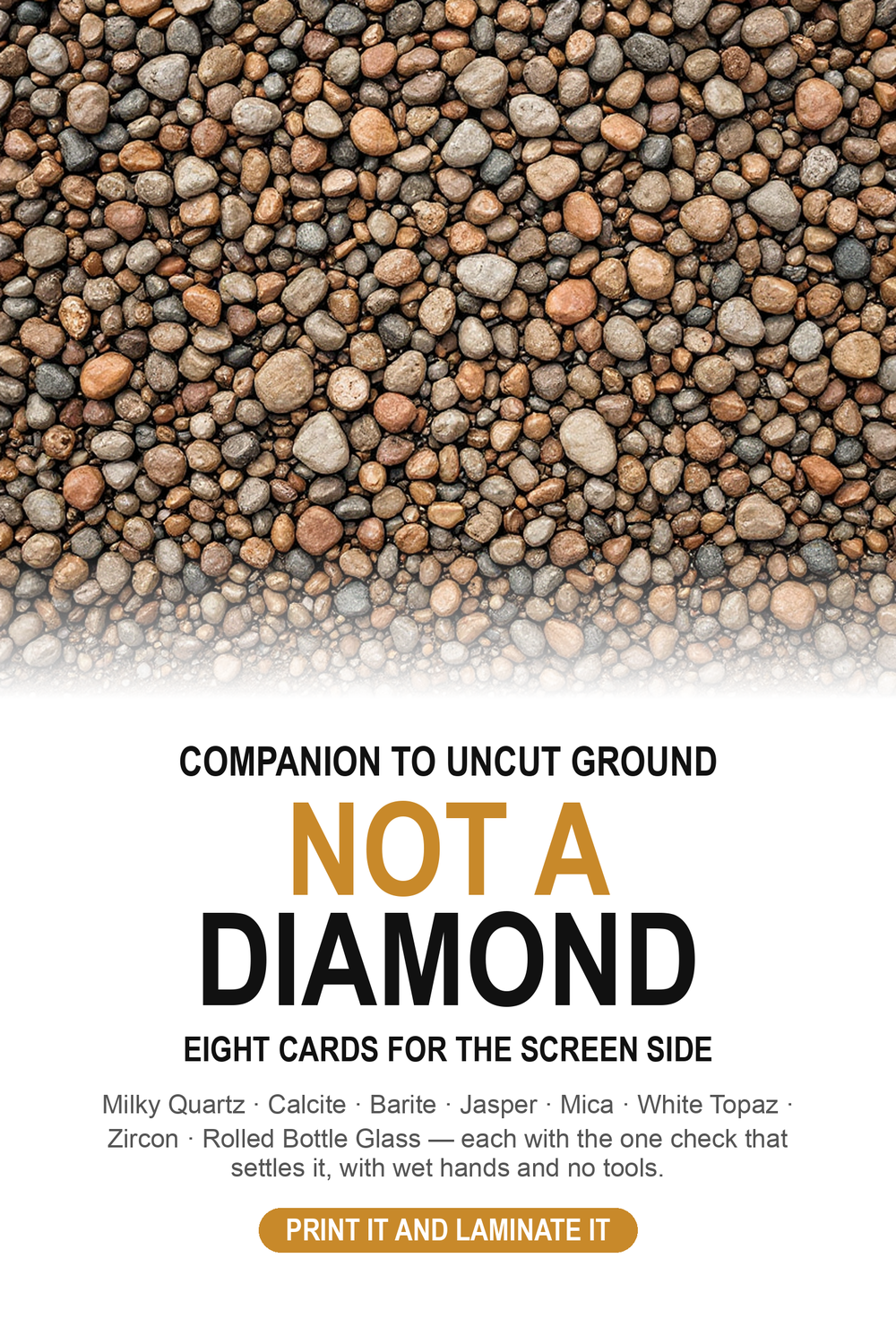
The book argues the eliminations and prints the sources. These carry the decision to the gravel, one pair at a time, where you have wet hands, no signal and no table. Twelve pages, US Letter, print and laminate — and no card needs colour to make its decision, so the printer in the garage will do.
What is deliberately not in the deck: the true-scale plate. That ships inside the book, as Appendix 1, so you are not paying for it twice. And six of the eight pair cards can end in not settled, because a deck that always decides is a deck that is lying to you.
Tick the box in the price card above and it is one payment, one checkout, both PDFs. It is also sold on its own afterwards, at the same price — the box is just the version without a second decision.
This is one product doing the job of two, and both anchors below are prices observed in this market on 12 August 2026 — not invented numbers with a line through them.
| A field-usable identification guide | Laminated, carried to the gravel, sold on durability as much as on content. One well-known line of them runs to thirteen titles, and not one of the thirteen is about diamond. | $29.95 |
| A diamond identification manual for the consumer | The standard format for learning to read the stone. Written about diamond after a cutter has finished with it. | $19.95 |
| Both, at what they actually cost | And neither one is about rough. | $49.90 |
| The Diamond Hunter's Bible | Both jobs in one file, about the stone before anybody cuts it. | $29 |
The $49 struck through at the top of this page is that total, rounded down. Rough-diamond identification written properly runs from about eighty-five dollars to well over a hundred, and it is written for cutters, sorters and exploration geologists. Instruction with a person standing next to you starts at a hundred and twenty-five for half a day. This is the same subject written for the man with a screen in a creek, and it costs less than two days of admission at the one place in this country where you may keep what you find.
This is a first edition and there are no reader reviews yet. When there are, they will appear here with the reader's name, state and the chapter he is talking about, and with a note saying whether he received an advance copy.
Seven Checks for the Stones You Already Brought Home
In 1928 two men pitching horseshoes in Monroe County, West Virginia turned a stone out of the dirt, decided it was bright quartz — there was plenty of quartz in that ground — and put it in a wooden cigar box in the tool shed. It came back out fourteen years later. It is about 34.5 carats and it is still the largest alluvial diamond ever found in North America.
You have a container of your own. The coffee can, the bucket by the back steps, the jar somebody carried up from a creek. This sheet runs seven checks on it, in a fixed order, tonight, with a glass of water, your fingernail, a steel knife and a quartz pebble out of the same bucket. It sorts a pile into three heaps: out, undecided, and worth showing somebody. It also names the four checks not to run, which is where most people in this hobby have been going wrong for years.
No cost, no card. One email with the PDF, then three short ones over the following nine days — what the shape of a dissolved surface tells you, the ground that carries these stones outside Arkansas, and a plain account of who this book is not for. Unsubscribe in one click.
No. It is a single PDF of 271 pages, delivered to your email within a minute of checkout, and it opens on a phone, a tablet or a computer. There is no shipping and nothing to wait for. If you add the card deck at checkout, that is a second PDF laid out for US Letter so you can print it, cut it and laminate it.
No, and deliberately not. Arkansas gives its own material away, the park staff identify rocks and minerals free of charge, and the one place in America where an expert is standing two hundred metres from you is the one place least worth writing about. The park appears in this book where it is the best available evidence — it is the deposit the science has actually been done on, and its rules are the most concrete safety code in the hobby. The value is the other forty-nine states, where you are alone with a handful of gravel.
Because the problem was never the videos. The problem is that every image of a diamond any of us has ever seen was of a finished stone, and no amount of watching corrects a picture that is wrong in the same direction every time. This is the reference you take to the gravel: fourteen chapters in a fixed order, searchable, with the source and the date of every load-bearing sentence so you can check the book rather than trust it. Watch the videos. Then have the thing that does not scroll away.
No. There is not one grid reference in it, not one go here. Site lists age in a season, they send people onto ground they have no right to be on, and they teach nothing that survives the trip. What is here instead is the ability to read a stone and read a piece of ground anywhere in the country, plus chapter 13 on who controls what, so that the ground you choose is one you may legally be on. Outside the one Arkansas search area, the answer to can I keep it is almost never a simple yes, and the book says so every time it comes up.
No, and no honest guide can. The value of rough is set by the world market on size, shape, colour and clarity, and by what a cutter believes he can get out of it — a state geological survey declines to put a price per carat on an entire deposit, so a pebble in your palm certainly has none. Chapter 14 covers what is actually known: how yield works, why grading applies to polished stones and not to rough, and a documented case where a 3.03-carat rough finished at 1.09. What it will not do is print a number, because any number would be invented.
Chapters 10 and 12 are the half of this subject nobody writes. Glacial drift country, the State Line district on the Colorado–Wyoming border, the auriferous gravels of California where diamonds turned up as a by-product of a completely different search, and the Appalachians, where the honest answer is one well-sourced stone and a pile of reports that do not meet this book's own standard. Where the record is thin, the book says the record is thin.
Nobody connected with this book claims to have stood on any ground, and there are no field anecdotes in it. It was assembled from published sources with the assistance of artificial intelligence, which is why every load-bearing sentence carries a named source and a date, why the four tags exist, and why Appendix 2 is as long as it is. You are not being asked to trust an author. You are being handed the sources, by page, so you can go and read them.
Read it. Take it to your own bucket and run chapter 2 and chapter 6 against what is in there. If it does not change what you keep and what you throw back, reply to your receipt within 60 days and you get every cent back. No form, no questions, and you keep the PDF — a file cannot be handed back, and pretending otherwise would be theatre.
Nobody can promise you a stone, and this book does not. What it can do is make sure that on the day one is lying in front of you, you are not the man who walks over it.
$49$29
$29 — the book, one PDF, delivered to your inbox
Secure Stripe checkout · the PDF arrives by email within a minute
Seven checks, in a fixed order, on stones you already own. A glass of water, your fingernail, a steel knife and a quartz pebble out of the same bucket. It costs nothing and it needs no trip.
No cost, no card. Unsubscribe in one click.